Home lighting technologies
Some of the most popular lighting technologies for home and commercial applications include:
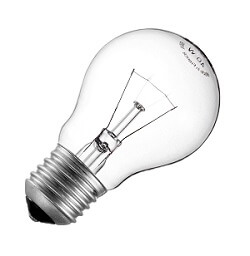 Incandescent lamps: This lamp consists of a glass spherical casing containing a wire thread. The electric current passes through the filament, which is then heated and radiates the energy as visible light. Incandescent has been the most common type of lamp for over 100 years and has long been the standard for color rendering and consumer expectations of how a bulb should work but is slowly being abolished by the Act for Energy Independence and Security 2007 due to its inefficiency. Most incandescent lamps will be out of production by the end of 2015. Incandescent lamps also emit a significant part of their energy as ultraviolet and infrared radiation, which is invisible to the human eye.
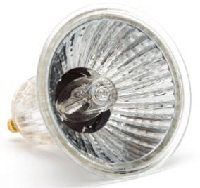 Halogen lamps: A more advanced form of incandescent, the halogen lamp uses natural halogen gas and a tungsten filament to increase the light it produces and the efficiency of the incandescent lamp. It is known for slightly higher performance than standard incandescent lamps and for brighter, whiter light than the original incandescent lamp. Halogen lamps are usually the first choice for homeowners, as they are more suitable for luminaires that offer directional illumination using various reflector styles such as spotlights. Halogen lamps are often used in projectors and in light and automobile lights. General Electric was the first to get the patent and began selling this type of lamp in 1959.
 Compact fluorescent lamps: Compact fluorescent lamps do not use a filament to produce light; instead, they use a phosphor-coated glass tube containing a small amount of argon and mercury vapor and electrodes at one end. When an electric current is applied, the electrodes generate an invisible ultraviolet light that then excites the fluorescent coating inside the tube to produce visible light. Initially, the lamp takes a little more time to light up, but once it lights up, it uses about 70% less energy than the corresponding incandescent lamp. The quality of the color rendering of the fluorescent lamps is usually lower compared to their halogen and incandescent lamps, but the use of a dimmer does not produce a smooth result.
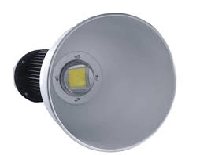 Metal Halide Lamps: High-intensity discharge technology is an arc lamp technology developed in the 1960s. In a glass casing filled with argon gas is a bow of either quartz or ceramic containing salts of mercury and metal halides. The mixture of natural gas, mercury, and halide salts inside the tube creates a bright bright white light when heated by the electric arc contained within it. Metal halide lamps are very efficient, have an excellent lifetime (over 20,000 hours) and are able to provide enormous luminous flux, so they are usually used in high ceiling installations requiring plenty of light, stadium lights, road lighting, as well as parking and other outdoor lighting applications. The main disadvantage of metal halide lamps is the ignition and the adjustment of the luminous flux. Most metal halide lamps can not light up while they are hot, which means that if there is a power cut, there will be a time of 15 to 20 minutes that is necessary for the lamps to cool enough to turn on again. In addition, it is almost impossible to produce low light. So, although they are great in producing a lot of light, you should want that exactly - because there is only one setting, and that is at 100%.there will also be a time of 15 to 20 minutes that is necessary for the lamps to cool enough to be able to light up again. In addition, it is almost impossible to produce low light. So, although they are great in producing a lot of light, you should want that exactly - because there is only one setting, and that is at 100%. there will also be a time of 15 to 20 minutes that is necessary for the lamps to cool enough to be able to light up again. In addition, it is almost impossible to produce low light. So, although they are great in producing a lot of light, you should want that exactly - because there is only one setting, and that is at 100%.
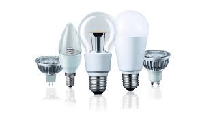 LED lamps: LEDs, or light-emitting curves, are a steady-state technology that does not include any filament, glass envelope, natural gas, or mercury. LEDs generate light with electron motion resulting from the application of an electrical voltage difference to a semiconductor material. Each semiconductor material produces light of a particular wavelength, so LEDs alone are not capable of producing white light. Similar to other technologies, white light can be created with a phosphor coating, while excitation energy is typically provided by a blue LED light. Although they do not warm up in the traditional sense, LEDs produce heat, just not in the beam of light: it comes out at the opposite end, and the correct removal of this heat through careful thermal management is critical to determining the lifetime of the light source. A hot LED will fail, but a well-designed LED light source can reach up to 50,000 hours of life or more (in lab conditions some LEDs have been said to have lasted over 100,000 hours). This transcends the lifetime of an incandescent bulb for tens of thousands of hours. While LED lighting at home is still not the most common form, LED lights have been used on various things for years, such as cell phones, Christmas lights, lanterns, and televisions. They can also use 90% less energy than incandescent lights, are environmentally friendly, have zero UV or mercury emissions, and are very durable. 000 hours of life or more (in lab conditions some LEDs have been said to have lasted over 100,000 hours). This transcends the lifetime of an incandescent bulb for tens of thousands of hours. While LED lighting at home is still not the most common form, LED lights have been used on various things for years, such as cell phones, Christmas lights, lanterns, and televisions. They can also use 90% less energy than incandescent lights, are environmentally friendly, have zero UV or mercury emissions, and are very durable. 000 hours of life or more (in lab conditions some LEDs have been said to have lasted over 100,000 hours). This transcends the lifetime of an incandescent bulb for tens of thousands of hours. While LED lighting at home is still not the most common form, LED lights have been used on various things for years, such as cell phones, Christmas lights, lanterns, and televisions. They can also use 90% less energy than incandescent lights, are environmentally friendly, have zero UV or mercury emissions, and are very durable. LED lights have been used on various things for years, such as mobile phones, Christmas lights, lanterns, and televisions. They can also use 90% less energy than incandescent lights, are environmentally friendly, have zero UV or mercury emissions, and are very durable. LED lights have been used on various things for years, such as mobile phones, Christmas lights, lanterns, and televisions. They can also use 90% less energy than incandescent lights, are environmentally friendly, have zero UV or mercury emissions, and are very durable.

Great job
ReplyDeleteThanks For sharing.
Dont Miss Best
Led lights pakistan
I have read all the comments and suggestions posted by the visitors for this article are very fine,We will wait for your next article so only.Thanks! Iron Man Lampe
ReplyDelete